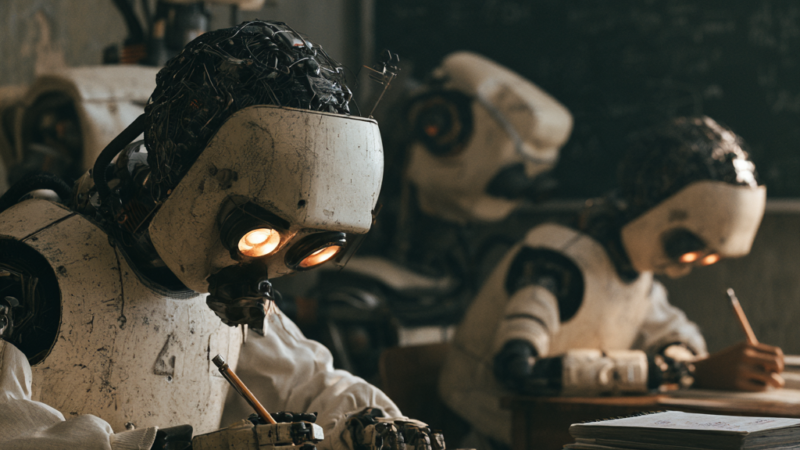
For a decade, AI progress lived on screens. That boundary is dissolving. The same architectures that learned language are now learning manipulation, and the cost of turning a design into an object has fallen to the point where a spare room can be a factory.
What actually changed in robotics
Traditional industrial robots are precise and stupid: they repeat an exact path in a controlled cell, and a part two centimetres out of place stops the line. What changed is generalisation. Robot foundation models trained across many tasks and many robot bodies can now attempt things they were not specifically programmed for — pick up an object they have never seen, follow a spoken instruction, recover from a slip.
Watch three fronts: Figure and Agility on humanoids in real warehouses, Unitree on driving hardware cost down to hobbyist range, and NVIDIA Isaac on the simulation and model stack most developers will build on.
The honest state of play
- Real: structured environments — warehouses, logistics, inspection, agriculture rows, controlled retail back-of-house.
- Emerging: unstructured manipulation, dextrous hands, multi-hour autonomy without human rescue.
- Still a demo: general-purpose household robots doing your actual chores. Every impressive video is either teleoperated, heavily edited, or performing in a rehearsed environment. Ask which, every time.
The bottleneck is no longer intelligence. It is data, reliability and unit economics — a robot has to work for eight hours without a technician to beat a human on cost.
3D printing: the underrated half
While robotics gets attention, distributed manufacturing quietly got good. Machines from Bambu Lab and Prusa print reliably out of the box, multi-material and multi-colour are routine, and libraries like MakerWorld and Thingiverse mean most parts already exist.
Combine that with generative CAD in Fusion or Onshape and the loop from idea to physical object collapses to hours. For anything beyond a prototype, Protolabs bridges to real manufacturing without a factory.
Business models that this unlocks
- Local on-demand parts. Replacement components for discontinued products — a genuinely underserved market with recurring demand.
- Custom fit goods. Anything sized to a body or a space: braces, mounts, inserts, enclosures.
- Design licensing. Sell the file, not the object. Zero inventory, global distribution, and creator payouts on model platforms are real income for good designers.
- Robot integration services. The gap between \”we bought a robot\” and \”it works in our facility\” is the highest-margin consulting of the next five years.
- Fleet maintenance. Every deployed robot needs someone local who can fix it. This is a trade, it pays well, and it is not going remote.
What this means for work
The comfortable assumption that physical work is safe from AI is weakening, but slowly and unevenly. Repetitive, structured physical work in a controlled space is exposed within this decade. Varied physical work in unpredictable environments — a plumber in an old house, a nurse on a ward, an electrician in a crawl space — remains extremely hard for machines, and the people doing it are getting scarcer, not more numerous.
If you want the diversification view, the survival guide covers where to place your effort. The frontier tech page keeps the full link list for robotics, printing and quantum.