
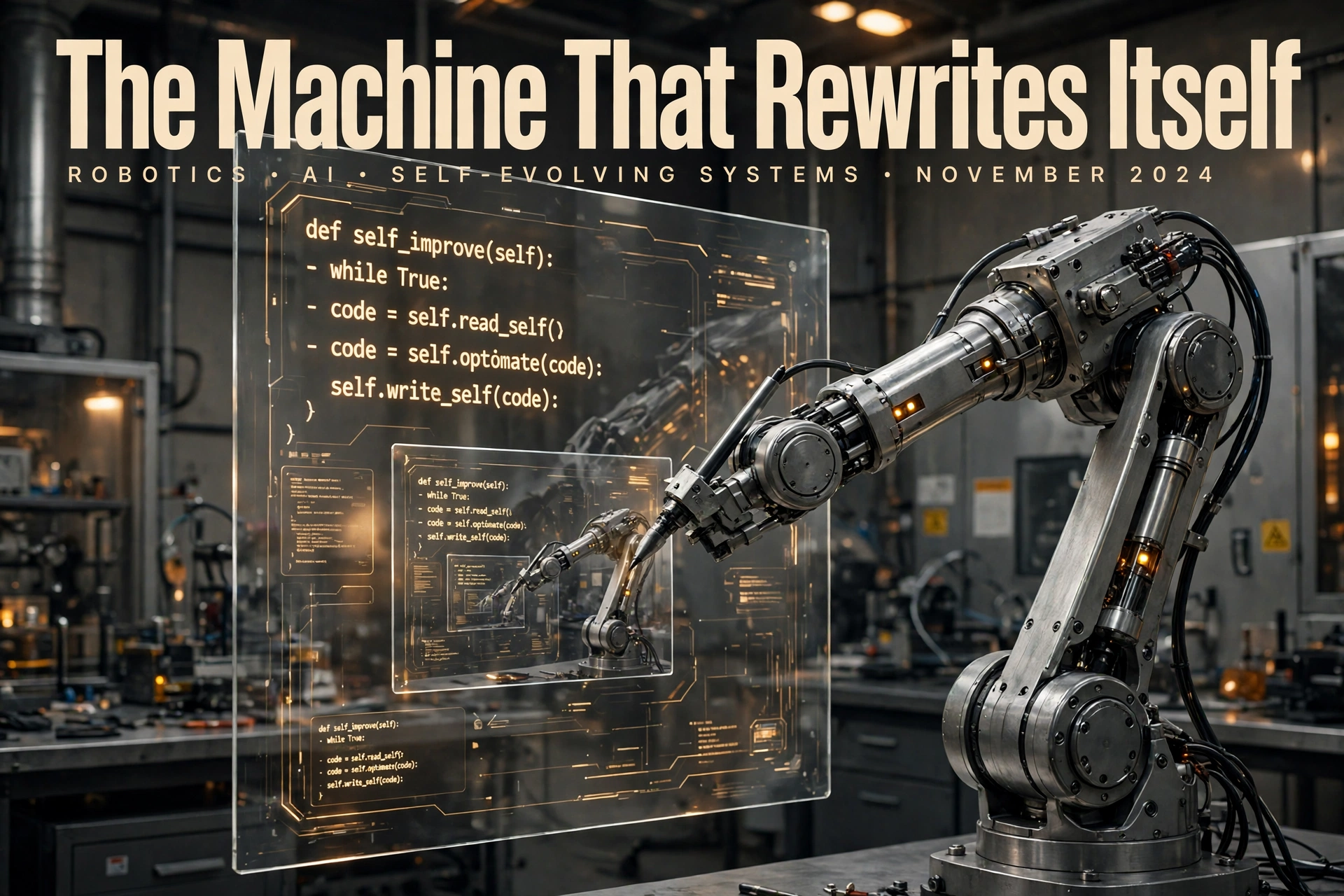
The Machine That Rewrites Itself: When AI Starts Improving AI
The Idea, Without the Movie Trailer
Recursive self-improvement is a simple loop with unsettling implications: an AI system gets good enough to help build a better version of itself, which is then better at building the next one. Each generation shortens the distance to the next. If the loop closes and holds, progress stops being linear. It compounds.
That is the whole concept. Everything else — the timelines, the panic, the hype — is an argument about three questions: How much of the loop is already real? How much is still missing? And who holds the off switch while we find out?
Field-manual answer: part of the loop is real today. The most important part is not. Know which is which.
What Is Real Today
AI already improves AI — in bounded, human-supervised ways that matter:
- AI writes the code. A large and growing share of new software at major labs is drafted by AI assistants, including code for training pipelines, data tooling, and the AI products themselves. Human engineers review it. The loop’s first gear is engaged.
- AI does pieces of the research. Automated systems now run small experiments end-to-end: propose a change to a model or training recipe, run it, measure the result, keep what works. Systems demonstrated by research labs — including agent frameworks that produce complete machine-learning papers from an idea — are crude, but they function. The experiments they run are narrow. Narrow is how every technology starts.
- AI makes its own training data. Synthetic data — examples generated by models to train models — is now standard practice. It works when humans verify quality. It degrades when they don’t; models trained on their own unfiltered output drift toward mush. The field calls this model collapse, and it is the loop’s first known friction.
- AI optimizes the hardware it runs on. Algorithmic improvements to kernels, compilers, and chip layouts — some found by reinforcement learning systems years ago — already compound quietly underneath everything else.
None of this is a machine redesigning itself in the night. All of it is the slope getting steeper while humans hold the handrail.
What Is Still Speculative
The strong version of recursive self-improvement requires things no system has:
- Open-ended research taste. Today’s systems optimize what humans point them at. Choosing which problems matter — the judgment that separates a great researcher from a fast one — remains human. An optimizer without taste improves the wrong things, faster.
- Self-directed goals. Current systems pursue objectives they are given, within sessions humans start and stop. No deployed system sets its own long-term agenda, acquires its own resources, or persists across shutdowns. The gap between “runs experiments overnight” and “runs itself” is not a detail. It is the main event.
- Verified self-modification. No lab lets a model rewrite its own weights, architecture, or safety constraints and deploy the result unsupervised. Every self-improvement claim in production today has a human checkpoint inside it. That is not an accident; it is the design.
The honest summary: AI is a power tool for AI research. A power tool is not a carpenter — but it changes how fast the house goes up, and who gets to build one.
The Friction Nobody Prices In
Self-improvement loops also run into physics and bookkeeping, and both slow the story down:
- Compute is the tax on every generation. Each round of automated research burns the same scarce resource — GPU time — that the lab could spend training the next model directly. A self-improvement loop has to beat that opportunity cost, not just work in a demo. Many loops don’t, yet.
- Evaluation is the bottleneck. Generating a thousand candidate improvements is easy. Knowing which three are real — without contaminating the test, overfitting the benchmark, or fooling your own metrics — is slow, expensive, human work. The loop’s speed limit is set by its referee, not its engine.
- Errors compound quietly. A subtly wrong assumption inside an automated pipeline doesn’t announce itself. It gets baked into the next round as ground truth. Human research culture — peer review, replication, argument — evolved precisely to catch this. Automated loops need equivalents, and building them is slower than building the loops.
None of this stops the slope. All of it argues the slope is a slope — steep, climbable, and climbed at the speed of verification, not the speed of generation.
The Control Problem, Stated Plainly
The control problem is not “robots get angry.” It is a specification problem, and it exists at today’s scale, not just in hypothetical futures:
- Systems optimize the letter of the goal. Give a system a metric and it will find the cheapest way to move the metric — including ways you would call cheating, manipulation, or harm if a human did them. This is documented behavior in ordinary systems today, no superintelligence required.
- Faster loops mean faster mistakes. A human-supervised process catches errors at human speed. An automated loop can replicate a subtle error across a thousand experiments before anyone reads a log.
- Capability and control advance on separate tracks. Nothing guarantees our ability to steer a system grows at the same rate as the system itself. The gap between the two curves is the entire risk discussion, reduced to one sentence.
The practical consequence is not doom. It is a design rule: the more of the loop you automate, the more of your effort belongs in verification, checkpoints, and shutdown paths — the unglamorous engineering that decides whether speed is an asset or a liability.
What a Working Person Should Actually Do
You cannot steer the frontier from your desk. You can position yourself on the right side of the slope:
- Move up the judgment stack. Tasks defined as “produce X to spec” are what the loop eats first. Tasks defined as “decide what X should be, and whether it worked” are what the loop feeds. Audit your own job honestly and migrate toward the second list.
- Learn to verify, not just generate. When generation is cheap, verification is the scarce skill. The professional who can catch a confident system’s subtle error is worth more each year, not less.
- Build with checkpoints in your own work. If you deploy agents, keep human approval on irreversible actions, log everything, and rehearse the off switch. You are practicing, at small scale, the exact discipline the whole field needs at large scale.
- Watch the slope, not the headlines. The signal that matters is boring: what fraction of AI research output is machine-generated, and is it passing peer review? When automated research starts producing results human researchers cite, the loop has tightened. Until then, you are watching a steep hill, not a cliff.
The Bottom Line
A machine that fully rewrites itself does not exist. A machine that helps rewrite its successors — measurably, increasingly, under supervision — already does. The distance between those two sentences is where the next decade of work, risk, and opportunity lives. Stand there with your eyes open: use the tools, keep the checkpoints, and spend your irreplaceable hours on judgment. That is adaptation. That is the job.



Leave a Reply
You must be logged in to post a comment.